
LakeGraph adds a governed relationship layer on top of Databricks so quality, procurement, and operations teams can trace parts, map supplier dependencies, and detect failure chains without moving sensitive production data into a separate system.
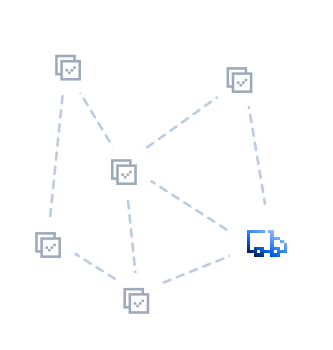
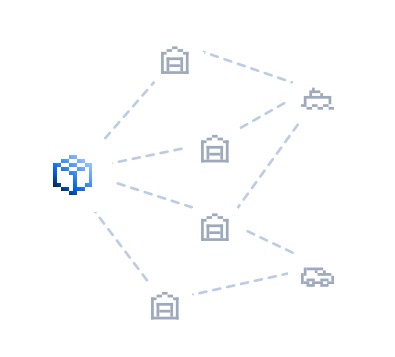

Query relationships on governed Delta tables in place.

Find rings and paths across accounts, devices, entities.

Align with existing access controls and audit needs.

Use graph signals in models, analytics, and apps.
Follow a defective part from raw material through every supplier, sub-assembly, and production line to identify every finished product that may be affected — across your entire supply chain graph.
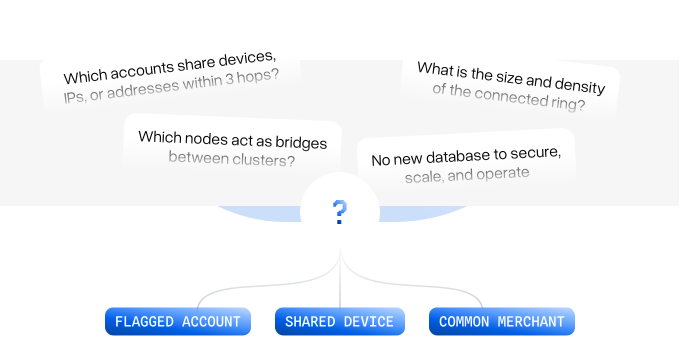
Map supplier dependencies to find hidden concentration. When one supplier feeds into dozens of product lines through intermediaries, LakeGraph surfaces the risk before disruption hits.
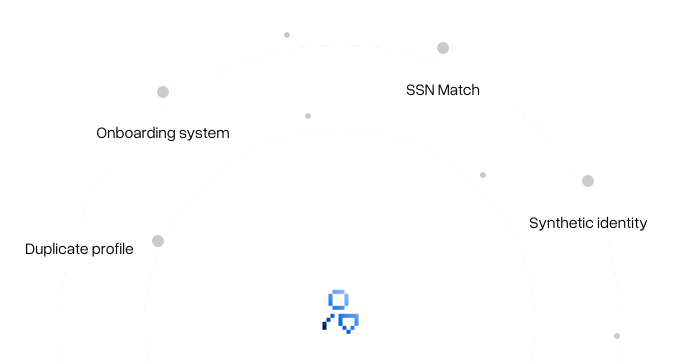
Cross-reference certifications, inspection records, and supplier networks to flag components that share suspicious provenance patterns — tracing through multiple tiers of the supply chain.
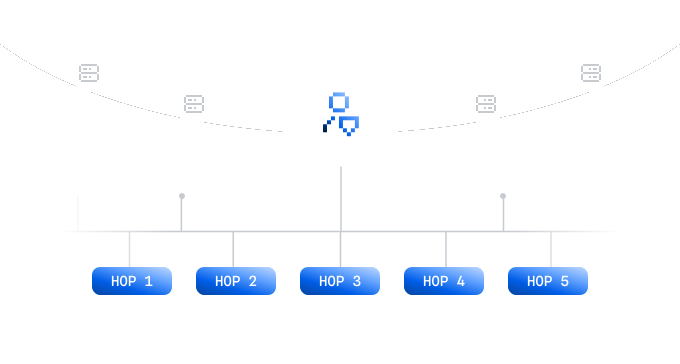
Enrich predictive maintenance models with graph features like supplier connectivity, component co-occurrence, and failure chain patterns computed directly on your Databricks lakehouse.
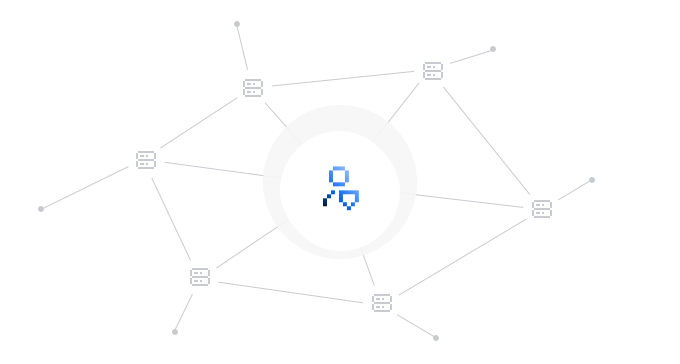
Follow a defective part from raw material through every supplier, sub-assembly, and production line to identify every finished product that may be affected — across your entire supply chain graph.
Map supplier dependencies to find hidden concentration. When one supplier feeds into dozens of product lines through intermediaries, LakeGraph surfaces the risk before disruption hits.
Cross-reference certifications, inspection records, and supplier networks to flag components that share suspicious provenance patterns — tracing through multiple tiers of the supply chain.
Enrich predictive maintenance models with graph features like supplier connectivity, component co-occurrence, and failure chain patterns computed directly on your Databricks lakehouse.
Follow a defective part from raw material through every supplier, sub-assembly, and production line to identify every finished product that may be affected — across your entire supply chain graph.
Map supplier dependencies to find hidden concentration. When one supplier feeds into dozens of product lines through intermediaries, LakeGraph surfaces the risk before disruption hits.
Cross-reference certifications, inspection records, and supplier networks to flag components that share suspicious provenance patterns — tracing through multiple tiers of the supply chain.
Enrich predictive maintenance models with graph features like supplier connectivity, component co-occurrence, and failure chain patterns computed directly on your Databricks lakehouse.
Follow a defective part from raw material through every supplier, sub-assembly, and production line to identify every finished product that may be affected — across your entire supply chain graph.
Match component identifiers across ERP, MES, and supplier systems.
Cross-reference certifications, inspection records, and supplier networks to flag components that share suspicious provenance patterns — tracing through multiple tiers of the supply chain.
Enrich predictive maintenance models with graph features like supplier connectivity, component co-occurrence, and failure chain patterns computed directly on your Databricks lakehouse.
Use joins for 2–6 hops
Investigations are slow & unpredictable
External graph DB means duplication & sync pipelines
Data in motion increases compliance & security risk
Use joins for 2–6 hops
Investigations are slow & unpredictable
External graph DB means duplication & sync pipelines
Data in motion increases compliance & security risk

Expand from a component to its full supply chain — every supplier, sub-supplier, and logistics partner.
Match component identifiers across ERP, MES, and supplier systems.
Trace how quality failures propagate from raw material to finished product.
Find shared suppliers, certifications, and logistics routes across product lines.
Use supplier connectivity and component co-occurrence as features in predictive models.
Connect your governed tables, declare relationships, and query multi hop connections without building new pipelines or maintaining a separate database.
Read governed data in place.
No exports, no duplication.
Define how entities connect. LakeGraph builds the graph index automatically.
Run traversals for investigations, analytics, and ML in the same environment.
Share your entity model. We will map relationships and show a ring expansion and exposure path traversal on a representative dataset.

We help you go from evaluation to production without breaking governance, access controls, or existing data workflows.
Align LakeGraph with your Databricks workspace setup, Delta tables, and security posture.
Guidance on permissions, data access patterns, and operating LakeGraph on governed datasets.
Monitoring recommendations, performance tuning, and runbooks for steady multi-team usage.
Yes. LakeGraph is designed to build a relationship layer directly on governed lakehouse tables, so teams can traverse relationships without maintaining a separate graph dataset.
Joins and views are strong for single-hop reporting. Manufacturing investigations often require multi-hop traversal across many entities. LakeGraph makes those traversals reusable.
Yes. You can model alternates, supersessions, variants, and time-bound relationships, then reuse that model across traceability, quality, and supply workflows.
Yes. A common pattern is connecting assets, components, telemetry, alarms, failures, and work orders to discover failure chains, leading indicators, and action effectiveness.
LakeGraph is designed to work with governed datasets and enterprise access controls in the lakehouse, so teams avoid creating a parallel security model in a separate system.
Pick one repeated investigation flow (recall impact, warranty root cause, or a top downtime driver). Model entities and relationships, then compare time-to-answer before and after.
Still have questions? Contact us now.


