LakeGraph adds a governed relationship layer on top of Databricks so fraud, risk, and compliance teams can trace rings, resolve identities, and quantify exposure without moving sensitive data into a separate graph database.
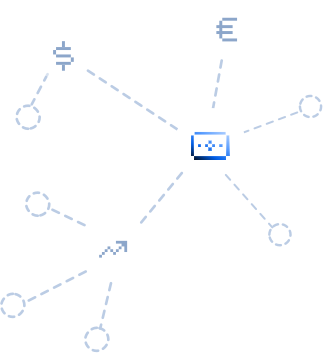
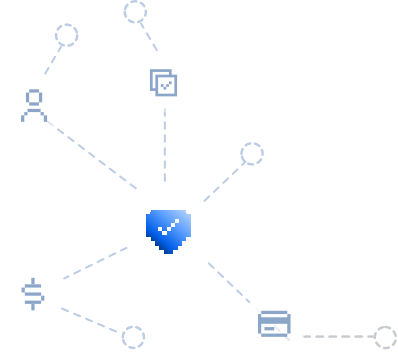

Query relationships on governed Delta tables in place.

Find rings and paths across accounts, devices, entities.

Align with existing access controls and audit needs.

Use graph signals in models, analytics, and apps.
Trace money flows across accounts, devices, and intermediaries to expose circular transfer patterns and coordinated fraud — in seconds, with data that never leaves your Databricks workspace.
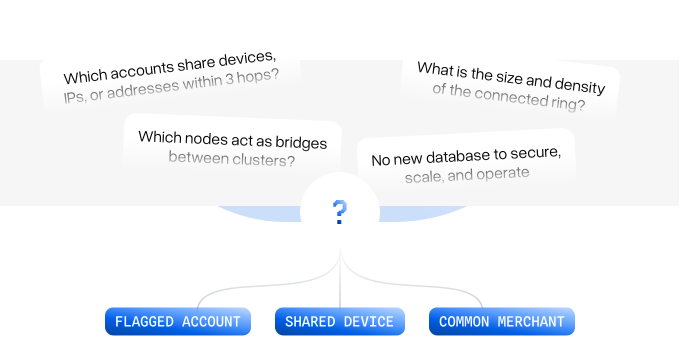
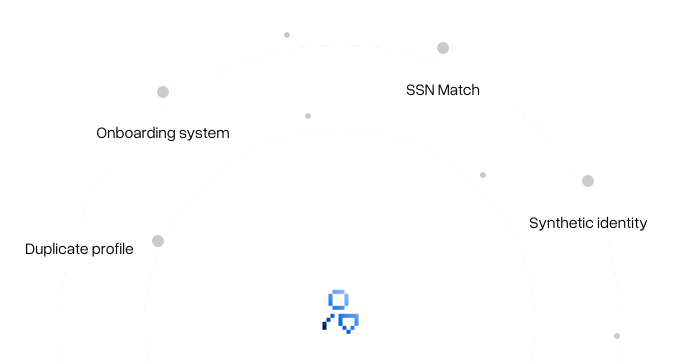
Unify customer identities across onboarding systems, transaction records, and third-party data. LakeGraph links shared attributes (SSN, phone, address, device) to surface duplicate and synthetic identities.
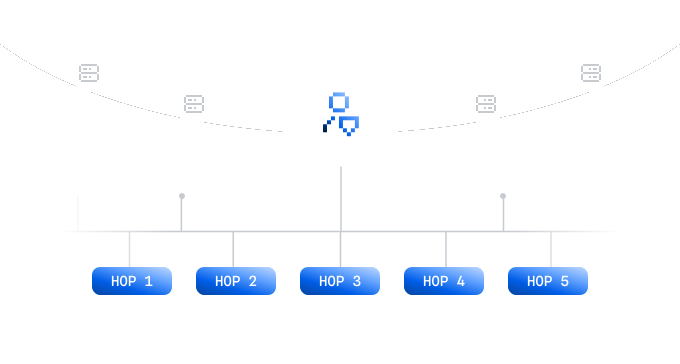
Map indirect exposure through multi-hop counterparty relationships. See how risk propagates through subsidiaries, guarantors, and shared collateral — up to 5 hops deep
Enrich ML feature stores with graph-derived signals like degree centrality, community membership, and anomaly scores — all computed inside Databricks and ready for your existing model pipelines.
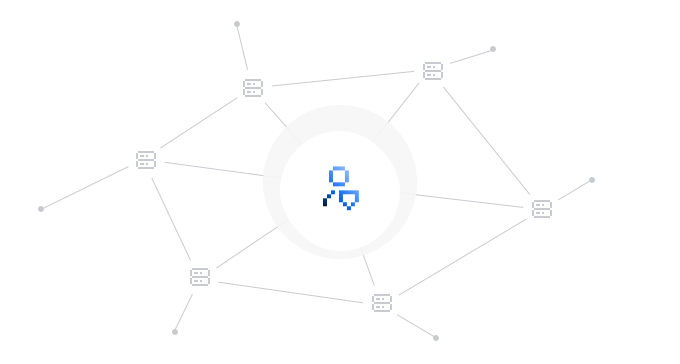
Trace money flows across accounts, devices, and intermediaries to expose circular transfer patterns and coordinated fraud — in seconds, with data that never leaves your Databricks workspace.
Unify customer identities across onboarding systems, transaction records, and third-party data. LakeGraph links shared attributes (SSN, phone, address, device) to surface duplicate and synthetic identities.
Map indirect exposure through multi-hop counterparty relationships. See how risk propagates through subsidiaries, guarantors, and shared collateral — up to 5 hops deep
Enrich ML feature stores with graph-derived signals like degree centrality, community membership, and anomaly scores — all computed inside Databricks and ready for your existing model pipelines.
Trace money flows across accounts, devices, and intermediaries to expose circular transfer patterns and coordinated fraud — in seconds, with data that never leaves your Databricks workspace.
Unify customer identities across onboarding systems, transaction records, and third-party data. LakeGraph links shared attributes (SSN, phone, address, device) to surface duplicate and synthetic identities.
Map indirect exposure through multi-hop counterparty relationships. See how risk propagates through subsidiaries, guarantors, and shared collateral — up to 5 hops deep
Enrich ML feature stores with graph-derived signals like degree centrality, community membership, and anomaly scores — all computed inside Databricks and ready for your existing model pipelines.
Trace money flows across accounts, devices, and intermediaries to expose circular transfer patterns and coordinated fraud — in seconds, with data that never leaves your Databricks workspace.
Unify identities across sources and preserve evidence links for audits and reviews.
Map indirect exposure through multi-hop counterparty relationships. See how risk propagates through subsidiaries, guarantors, and shared collateral — up to 5 hops deep
Enrich ML feature stores with graph-derived signals like degree centrality, community membership, and anomaly scores — all computed inside Databricks and ready for your existing model pipelines.
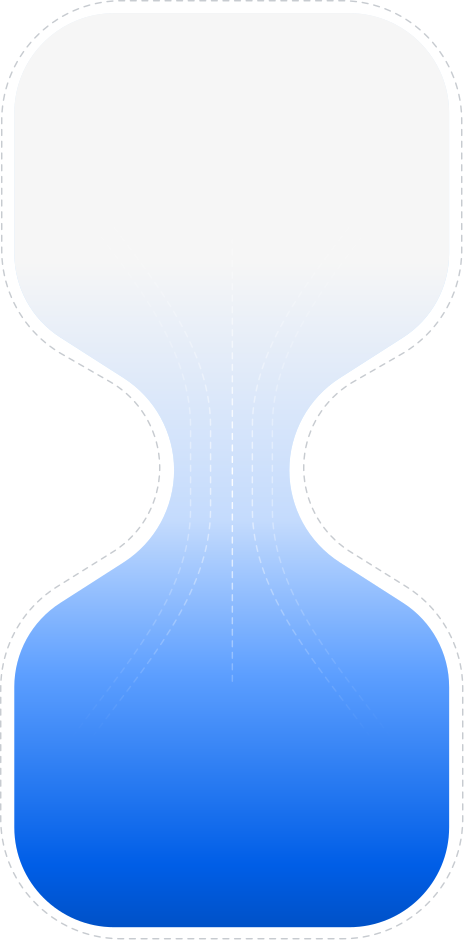
Use joins for 2–6 hops
Investigations are slow & unpredictable
External graph DB means duplication & sync pipelines
Data in motion increases compliance & security risk
Use joins for 2–6 hops
Investigations are slow & unpredictable
External graph DB means duplication & sync pipelines
Data in motion increases compliance & security risk

Expand from an alert to its connected neighborhood and measure size, density, and bridges.
Unify identities across sources and preserve evidence links for audits and reviews.
Compute shortest paths, indirect exposure, and critical intermediaries in seconds.
Find shared devices, IPs, addresses, and payment instruments across many entities.
Use adjacency, centrality, and community membership as features for risk models.
Use the same relationship layer across analytics, ML pipelines, and applications.
Connect your governed tables, declare relationships, and query multi hop connections without building new pipelines or maintaining a separate database.
Read governed data in place.
No exports, no duplication.
Define how entities connect. LakeGraph builds the graph index automatically.
Run traversals for investigations, analytics, and ML in the same environment.
Share your entity model. We will map relationships and show a ring expansion and exposure path traversal on a representative dataset.

We help you go from evaluation to production without breaking governance, access controls, or existing data workflows.
Align LakeGraph with your Databricks workspace setup, Delta tables, and security posture.
Guidance on permissions, data access patterns, and operating LakeGraph on governed datasets.
Monitoring recommendations, performance tuning, and runbooks for steady multi-team usage.
Quick answers to common questions about how relationship-based analysis helps uncover fraud, risk, and hidden connections.
Quick answers to common questions about how relationship-based analysis helps uncover fraud, risk, and hidden connections.
Quick answers to common questions about how relationship-based analysis helps uncover fraud, risk, and hidden connections.
Quick answers to common questions about how relationship-based analysis helps uncover fraud, risk, and hidden connections.
Quick answers to common questions about how relationship-based analysis helps uncover fraud, risk, and hidden connections.
Quick answers to common questions about how relationship-based analysis helps uncover fraud, risk, and hidden connections.
Still have questions? Contact us now.


