LakeGraph adds a governed relationship layer on top of Databricks so investment, risk, and research teams can map ownership chains, tenant relationships, and market exposure without moving sensitive deal data outside your workspace.

Query relationships on governed Delta tables in place.

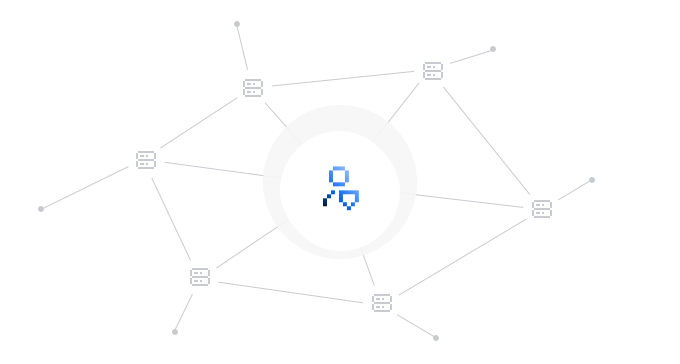
Find rings and paths across accounts, devices, entities.

Align with existing access controls and audit needs.

Use graph signals in models, analytics, and apps.
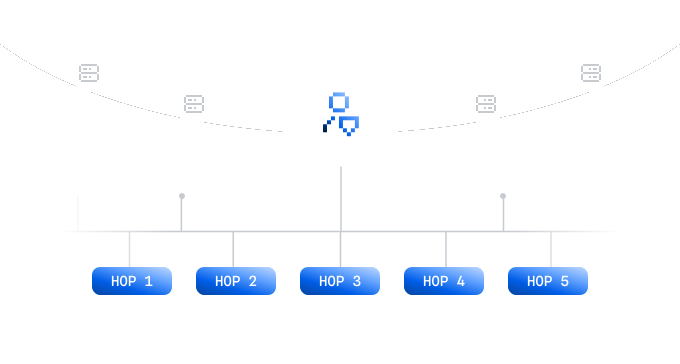
Trace ownership through LLCs, funds, and holding companies to identify the ultimate beneficial owners behind any property — traversing corporate entity chains up to 5 layers deep.
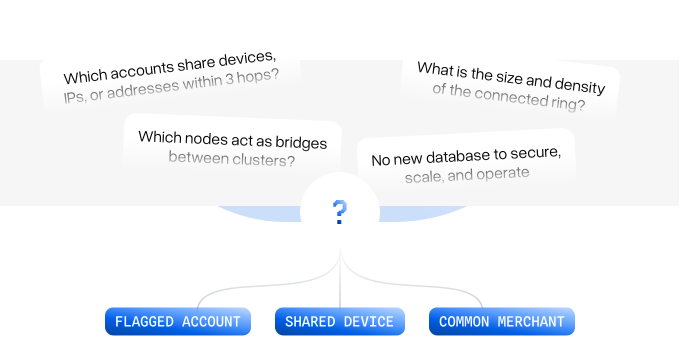
Discover hidden exposure when seemingly separate properties share common ownership, financing, or tenant relationships. Surface concentration risks that spreadsheet analysis misses.
Connect tenants, lease terms, and properties across portfolios to identify co-tenancy patterns, anchor tenant dependencies, and lease rollover clusters.
Add graph-derived signals — ownership complexity, submarket connectivity, tenant network density — to your existing Databricks pricing and risk models.
Trace ownership through LLCs, funds, and holding companies to identify the ultimate beneficial owners behind any property — traversing corporate entity chains up to 5 layers deep.
Discover hidden exposure when seemingly separate properties share common ownership, financing, or tenant relationships. Surface concentration risks that spreadsheet analysis misses.
Connect tenants, lease terms, and properties across portfolios to identify co-tenancy patterns, anchor tenant dependencies, and lease rollover clusters.
Add graph-derived signals — ownership complexity, submarket connectivity, tenant network density — to your existing Databricks pricing and risk models.
Trace ownership through LLCs, funds, and holding companies to identify the ultimate beneficial owners behind any property — traversing corporate entity chains up to 5 layers deep.
Discover hidden exposure when seemingly separate properties share common ownership, financing, or tenant relationships. Surface concentration risks that spreadsheet analysis misses.
Connect tenants, lease terms, and properties across portfolios to identify co-tenancy patterns, anchor tenant dependencies, and lease rollover clusters.
Add graph-derived signals — ownership complexity, submarket connectivity, tenant network density — to your existing Databricks pricing and risk models.
Trace ownership through LLCs, funds, and holding companies to identify the ultimate beneficial owners behind any property — traversing corporate entity chains up to 5 layers deep.
Resolve entities across county records, SEC filings, and deal databases.
Connect tenants, lease terms, and properties across portfolios to identify co-tenancy patterns, anchor tenant dependencies, and lease rollover clusters.
Add graph-derived signals — ownership complexity, submarket connectivity, tenant network density — to your existing Databricks pricing and risk models.
Use joins for 2–6 hops
Investigations are slow & unpredictable
External graph DB means duplication & sync pipelines
Data in motion increases compliance & security risk
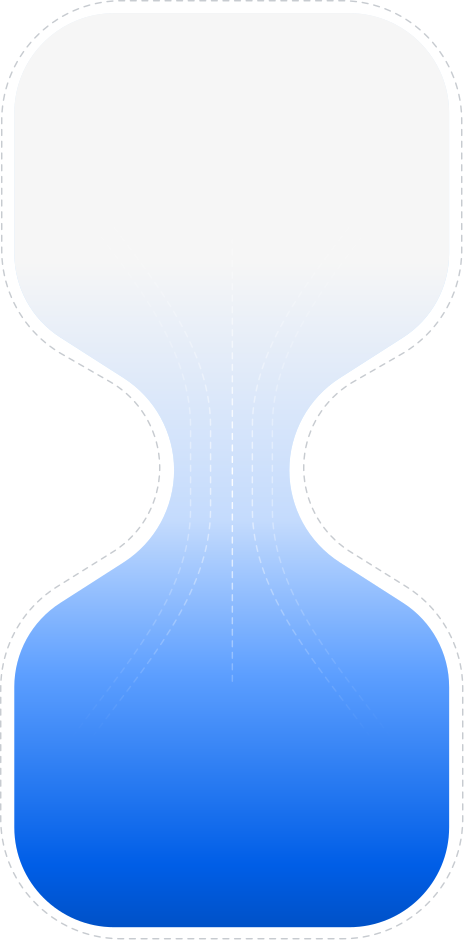
Use joins for 2–6 hops
Investigations are slow & unpredictable
External graph DB means duplication & sync pipelines
Data in motion increases compliance & security risk

Expand from a property to its full ownership structure — parent entities, funds, and beneficial owners.
Resolve entities across county records, SEC filings, and deal databases.
Compute ownership paths, investment flows, and indirect control through corporate layers.
Find common owners, managers, and lenders across properties and markets.
Use submarket connectivity and ownership complexity as features in pricing models.
Connect your governed tables, declare relationships, and query multi hop connections without building new pipelines or maintaining a separate database.
Read governed data in place.
No exports, no duplication.
Define how entities connect. LakeGraph builds the graph index automatically.
Run traversals for investigations, analytics, and ML in the same environment.
Share your entity model. We will map relationships and show a ring expansion and exposure path traversal on a representative dataset.

We help you go from evaluation to production without breaking governance, access controls, or existing data workflows.
Align LakeGraph with your Databricks workspace setup, Delta tables, and security posture.
Guidance on permissions, data access patterns, and operating LakeGraph on governed datasets.
Monitoring recommendations, performance tuning, and runbooks for steady multi-team usage.
Yes. Lease structures change over time. A relationship model can represent amendments, step-ups, renewals, and options as explicit, queryable connections.
No. The goal is to query relationships on governed lakehouse tables, so you avoid building a separate graph store and sync pipeline.
Pick one repeated workflow: tenant concentration, maturity clustering, or lease rollups. Model the key entities and compare time-to-answer before and after.
Yes. Relationships help explain why two assets are comparable or not comparable by considering tenant profile, lease structure, and counterparty overlap.
LakeGraph is designed to align with enterprise governance and access controls used in the lakehouse, so teams can reason over relationships within existing guardrails.
No. It complements them. BI and warehousing handle reporting and aggregates. LakeGraph focuses on multi-hop relationship queries that are hard to express and reuse with joins alone.
Still have questions? Contact us now.


