
LakeGraph adds a governed relationship layer on top of Databricks so clinical, compliance, and analytics teams can connect patients, providers, claims, and referrals without moving PHI outside your HIPAA-compliant environment.

Query relationships on governed Delta tables in place.

Find rings and paths across accounts, devices, entities.

Align with existing access controls and audit needs.

Use graph signals in models, analytics, and apps.
Trace referral patterns and billing relationships across providers, facilities, and patients to expose coordinated fraud rings — with data that never leaves your HIPAA-compliant Databricks workspace.
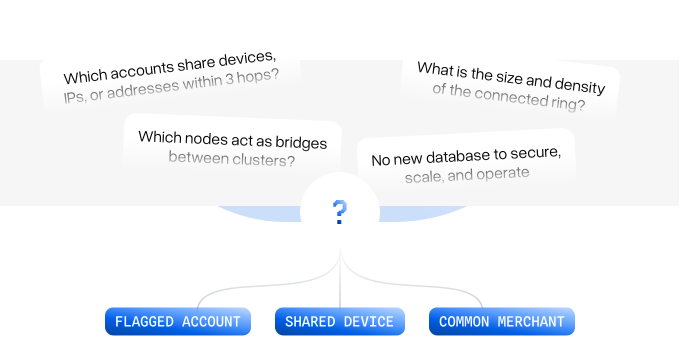
Connect encounters, referrals, prescriptions, and outcomes to visualize complete care journeys. Identify patients falling through gaps in care coordination.
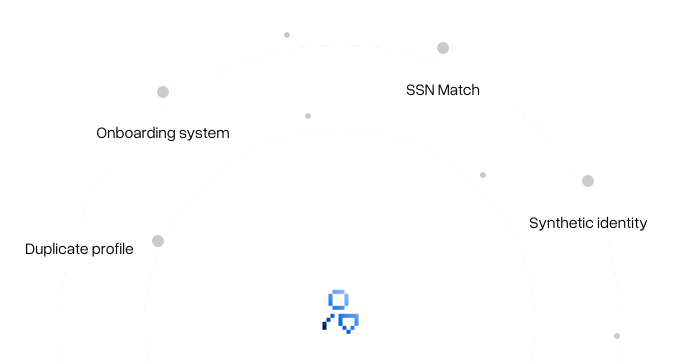
Surface unusual referral patterns, outlier billing relationships, and network structures that indicate waste, abuse, or compliance risk across provider networks.
Add graph-derived features — provider connectivity, care team structure, referral centrality — to population health models running in your existing Databricks ML pipelines.
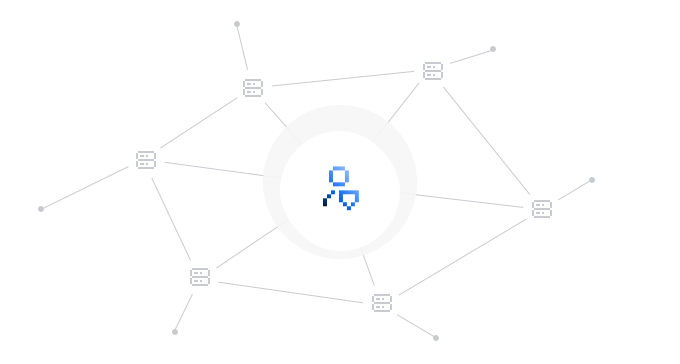
Trace referral patterns and billing relationships across providers, facilities, and patients to expose coordinated fraud rings — with data that never leaves your HIPAA-compliant Databricks workspace.
Connect encounters, referrals, prescriptions, and outcomes to visualize complete care journeys. Identify patients falling through gaps in care coordination.
Surface unusual referral patterns, outlier billing relationships, and network structures that indicate waste, abuse, or compliance risk across provider networks.
Add graph-derived features — provider connectivity, care team structure, referral centrality — to population health models running in your existing Databricks ML pipelines.
Trace referral patterns and billing relationships across providers, facilities, and patients to expose coordinated fraud rings — with data that never leaves your HIPAA-compliant Databricks workspace.
Connect encounters, referrals, prescriptions, and outcomes to visualize complete care journeys. Identify patients falling through gaps in care coordination.
Surface unusual referral patterns, outlier billing relationships, and network structures that indicate waste, abuse, or compliance risk across provider networks.
Add graph-derived features — provider connectivity, care team structure, referral centrality — to population health models running in your existing Databricks ML pipelines.
Trace referral patterns and billing relationships across providers, facilities, and patients to expose coordinated fraud rings — with data that never leaves your HIPAA-compliant Databricks workspace.
Unify patient records across EMR, claims, and pharmacy systems.
Surface unusual referral patterns, outlier billing relationships, and network structures that indicate waste, abuse, or compliance risk across provider networks.
Add graph-derived features — provider connectivity, care team structure, referral centrality — to population health models running in your existing Databricks ML pipelines.
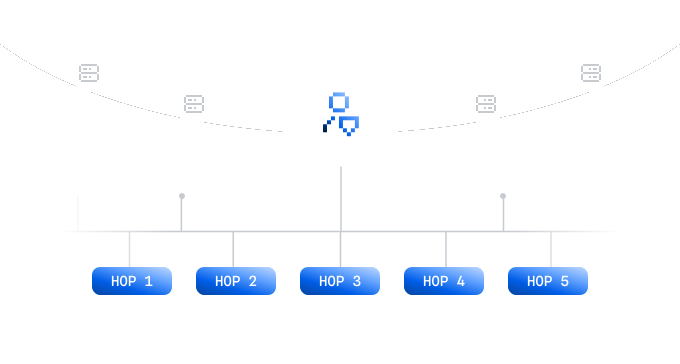
Use joins for 2–6 hops
Investigations are slow & unpredictable
External graph DB means duplication & sync pipelines
Data in motion increases compliance & security risk
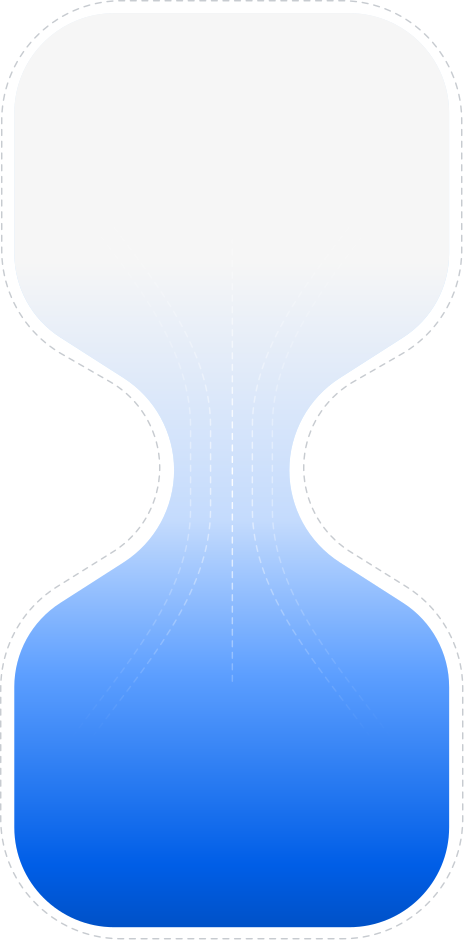
Use joins for 2–6 hops
Investigations are slow & unpredictable
External graph DB means duplication & sync pipelines
Data in motion increases compliance & security risk

Expand from a suspicious claim to its full provider-patient-facility network.
Unify patient records across EMR, claims, and pharmacy systems.
Map referral chains and treatment sequences across providers and facilities.
Find shared NPIs, facility affiliations, and referral patterns across organizations.
Use referral graphs and care team structures as features in outcome prediction models.
Connect your governed tables, declare relationships, and query multi hop connections without building new pipelines or maintaining a separate database.
Read governed data in place.
No exports, no duplication.
Define how entities connect. LakeGraph builds the graph index automatically.
Run traversals for investigations, analytics, and ML in the same environment.
Share your entity model. We will map relationships and show a ring expansion and exposure path traversal on a representative dataset.

We help you go from evaluation to production without breaking governance, access controls, or existing data workflows.
Align LakeGraph with your Databricks workspace setup, Delta tables, and security posture.
Guidance on permissions, data access patterns, and operating LakeGraph on governed datasets.
Monitoring recommendations, performance tuning, and runbooks for steady multi-team usage.
No. The goal is to query relationships on governed lakehouse tables, so you avoid creating additional copies of PHI and parallel security policies.
LakeGraph is designed to align with enterprise governance and access controls used in the lakehouse, so teams can reason over relationships within existing guardrails.
Yes. Healthcare identity often requires linking partial and changing identifiers. A relationship model can represent these links explicitly instead of burying logic in repeated joins.
It supports common relationship patterns across providers, payers, and life sciences, including member and claim relationships, network structures, and cohort discovery.
Pick one repeated investigation flow: referral leakage, claims integrity review, or a pathway and readmission analysis. Model the key entities and relationships, then compare time-to-answer before and after.
It typically complements master data efforts. MDM helps standardize entities, while LakeGraph focuses on making relationships and traversals reusable across teams and tools.
Still have questions? Contact us now.


